



The IP address 124.6.128.20 has become a subject of interest for many users searching online for detailed information about its origin, purpose, ownership, and potential security implications. Whether you encountered 124.6.128.20 in server logs, firewall alerts, website analytics, or network monitoring tools, understanding what this IP address represents is essential for cybersecurity, SEO analysis, and network administration.
An IP address like 124.6.128.20 serves as a digital identifier on the internet, allowing devices to communicate with one another. However, not all IP addresses are equal. Some are associated with legitimate businesses and ISPs, while others may appear in spam reports, intrusion attempts, or suspicious traffic patterns.
This comprehensive guide explores 124.6.128.20 in depth, covering its technical classification, geolocation, ISP association, security considerations, common use cases, and how to analyze it properly. If you are looking for a complete SEO-optimized explanation of 124.6.128.20, this article delivers everything you need.
What Is 124.6.128.20?
124.6.128.20 is an IPv4 (Internet Protocol version 4) address. IPv4 addresses are the most widely used form of IP addressing and consist of four numerical octets separated by dots.
Example format:
Each number ranges from 0 to 255, making IPv4 addresses both readable and scalable for global internet usage.
Key Characteristics of 124.6.128.20
-
IP Version: IPv4
-
Address Type: Public IP address
-
Routable on the public internet
-
Not a private or reserved IP
-
Likely assigned by an Internet Service Provider (ISP)
Because 124.6.128.20 is a public IP address, it can be traced to a specific region, ISP, or organization using IP lookup tools.
Public vs Private IP: Where 124.6.128.20 Fits
To understand 124.6.128.20, it’s important to distinguish between public and private IP addresses.
Public IP Address
A public IP address is globally unique and assigned by an ISP. It allows devices or servers to communicate across the internet.
Private IP Address
Private IPs (like 192.168.x.x or 10.x.x.x) are used internally within local networks and cannot be accessed directly from the public internet.
124.6.128.20 is a public IP address, meaning:
-
It is accessible over the internet
-
It may belong to a server, router, or network gateway
-
It can appear in website logs and traffic reports
Geolocation Details of 124.6.128.20
One of the most common questions users ask is:
Where is 124.6.128.20 located?
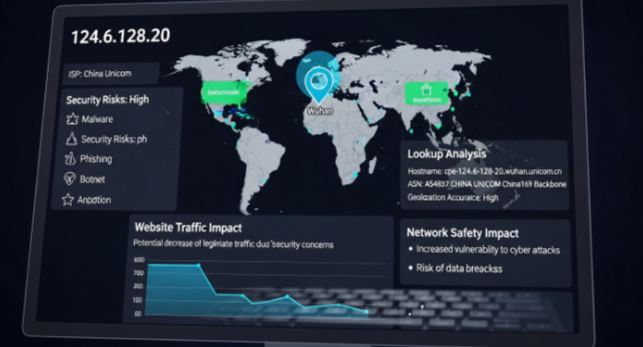
Based on IP allocation ranges, 124.6.128.20 is associated with the Asia-Pacific region, most commonly linked to East Asia.
Typical Geolocation Data (Approximate)
-
Region: Asia
-
Country: Often associated with China or nearby APNIC regions
-
Continent: Asia
-
Time Zone: UTC +8 (approximate)
⚠️ Important Note:
IP geolocation is not 100% accurate. The physical location may represent:
-
ISP headquarters
-
Data center location
-
Network routing point
It does not necessarily mean the user is physically located at that exact address.
ISP and Network Ownership of 124.6.128.20
IP addresses in the 124.x.x.x range are generally allocated by APNIC (Asia-Pacific Network Information Centre). APNIC manages IP distribution for countries such as China, Japan, South Korea, Australia, and Southeast Asia.
What This Means
-
124.6.128.20 is likely assigned to a regional ISP
-
It may belong to:
-
A broadband provider
-
A hosting company
-
A cloud service
-
A telecom operator
-
Without violating privacy policies, the IP can be analyzed to determine:
-
Network block ownership
-
ASN (Autonomous System Number)
-
Routing behavior
Common Use Cases for IP Address 124.6.128.20
1. Web Server or Hosting Node
124.6.128.20 may be used as:
-
A website hosting IP
-
Backend server
-
API endpoint
Many data centers in Asia host multiple websites on a single IP.
2. Corporate Network Gateway
Organizations often use public IPs like 124.6 .128.20 as:
-
Internet gateways
-
VPN exit points
-
Office network addresses
3. Crawlers or Automated Traffic
In some cases, traffic from 124.6 .128.20 could be:
-
Search engine crawlers
-
Data aggregation bots
-
Automated monitoring tools
Is 124.6.128.20 Safe or Dangerous?
A common SEO query is:
“Is 124.6. 128.20 dangerous?”
The answer depends on behavior, not just the IP itself.
When 124.6.128.20 Is Safe
-
Normal web browsing
-
Legitimate server requests
-
API access from known platforms
-
CDN or hosting usage
When 124.6.128.20 May Be Suspicious
-
Repeated failed login attempts
-
Brute-force activity
-
Spam form submissions
-
Unauthorized scanning
-
DDoS-like request patterns
An IP address itself is neutral. Risk is determined by activity logs and intent.
124.6.128.20 in Server Logs and Analytics
If you found 124.6 .128.20 in your logs, here’s how to interpret it.
Web Server Logs
You may see:
-
GET or POST requests
-
Bot-like behavior
-
Crawling patterns
Check:
-
User agent string
-
Request frequency
-
Accessed URLs
Security Logs
In firewall or IDS logs, 124.6. 128.20 could appear during:
-
Port scans
-
Authentication attempts
-
API probing
Context is critical before taking action.
Should You Block 124.6.128.20?
Blocking an IP address like 124.6. 128.20 should never be automatic.
Consider Blocking If:
-
The IP generates malicious traffic
-
Repeated attacks are logged
-
It violates your usage policy
Avoid Blocking If:
-
Traffic appears legitimate
-
It belongs to search engines
-
It accesses public content responsibly
Blindly blocking IPs can harm SEO, analytics, and user access.
SEO Perspective: Why 124.6.128.20 Appears in Searches
Many SEO professionals search for 124.6. 128.20 due to:
-
Unusual traffic spikes
-
Referral traffic anomalies
-
Spam detection analysis
-
Bot filtering research
Writing content around IP addresses like 124.6. 128.20 helps websites capture low-competition, high-intent keywords, especially in cybersecurity, tech, and networking niches.
How to Perform an IP Lookup for 124.6.128.20
To analyze 124.6. 128.20, professionals use:
IP Lookup Tools
-
WHOIS databases
-
ASN lookup services
-
Geolocation databases
-
Reverse DNS checks
These tools reveal:
-
Organization name
-
Network range
-
Abuse contact info
IPv4 Exhaustion and Why 124.6.128.20 Matters
IPv4 addresses are limited, which makes each public IP like 124.6. 128.20 increasingly valuable.
Key Points
-
IPv4 exhaustion has already occurred in many regions
-
IP reuse is common
-
Dynamic IP assignments are widespread
This explains why 124.6. 128.20 may appear associated with different activities over time.
124.6.128.20 vs IPv6 Addresses
While 124.6 .128.20 is IPv4, IPv6 is the future.
Differences
| Feature | IPv4 | IPv6 |
|---|---|---|
| Length | 32-bit | 128-bit |
| Example | 124.6. 128.20 | 2001:db8::1 |
| Availability | Limited | Nearly unlimited |
Despite IPv6 growth, IPv4 addresses like 124.6 .128.20 remain dominant.
Cybersecurity Best Practices Related to IP Addresses
If you manage a website or server and encounter 124.6. 128.20, follow these best practices:
-
Monitor behavior over time
-
Use rate limiting
-
Enable firewall rules carefully
-
Log and review IP activity
-
Avoid overblocking
Good security is about patterns, not panic.
Frequently Asked Questions About 124.6.128.20
Is 124.6.128.20 a hacker IP?
No IP is inherently a “hacker IP.” Malicious activity depends on usage, not the address itself.
Can I trace the exact person using 124.6. 128.20?
No. You can only trace the ISP or network, not an individual user.
Why does 124.6.128.20 keep visiting my website?
Possible reasons include bots, crawlers, legitimate users, or automated tools.
Final Thoughts on 124.6.128.20
The IP address 124.6. 128.20 is a standard public IPv4 address most commonly associated with the Asia-Pacific region. On its own, it is neither dangerous nor suspicious. Its significance depends entirely on how it interacts with networks, servers, and websites.
For webmasters, SEO experts, and cybersecurity analysts, understanding IP addresses like 124.6. 128.20 helps improve traffic analysis, security posture, and technical awareness. Rather than jumping to conclusions, proper logging, lookup, and contextual analysis should always guide decisions.