




In the current high-tech dynamic environment of the digital world, software developers, data analysts, and automation experts are continually seeking tools to assist them in enhancing productivity. In the current programming world, the keyword that is gaining reasonable interest among software developers is data softout4.v6 python. Although information on this keyword is not readily available, this term can be seen as a hypothetical programming environment, toolkit, or framework that is designed to assist developers in optimizing structured data handling.
This informative article is designed to help you get all the information you need to know on the topic of data softout4.v6 python. This article has been designed with search engine optimization best practices for achieving good search engine visibility. By the time you finish reading this article, you’ll have a better appreciation of what data softout 4.v6 python is all about.
What Is Data Softout4.v6 Python?
Data softout4.v6 python can be interpreted as a versioned Python data-processing module or framework built to:
-
Manage structured and semi-structured datasets
-
Automate extraction, transformation, and output operations
-
Provide scalable scripting for analytics or reporting
-
Improve interoperability between data sources and applications
The naming convention suggests:
-
Data → Core focus on information handling
-
Softout → Software output or structured export system
-
4.v6 → Version or release identifier
-
Python → Implementation language
In SEO and technical contexts, such compound identifiers often describe internal enterprise tools, automation scripts, or modular data frameworks rather than public open-source libraries.
Core Features of Data Softout4.v6 Python
1. data softout4.v6 python: Structured Data Processing
At its foundation, data softout 4.v6 python likely emphasizes:
-
CSV, JSON, XML parsing
-
Database query integration
-
Batch transformation pipelines
-
Data validation rules
Python’s ecosystem—especially pandas, NumPy, and SQL connectors—makes it ideal for this type of structured processing.
Why It Matters
Organizations depend on reliable data transformation layers to:
-
Clean incoming datasets
-
Normalize inconsistent formats
-
Prepare analytics-ready outputs
A tool aligned with data softout4.v6 python principles would simplify these operations.
2. Automated Output Generation
The phrase softout strongly implies software-driven output delivery.
Possible capabilities include:
-
Automated report generation
-
File exports to multiple formats
-
Scheduled data publishing
-
Integration with dashboards or APIs
Automation reduces manual intervention and improves operational efficiency.
3. Versioned Workflow Stability
The v6 marker indicates iterative improvement and:
-
Backward compatibility
-
Performance tuning
-
Security refinements
-
Expanded data connectors
Versioning is essential in enterprise data environments where stability matters more than novelty.
4. Python-Based Modularity
Because the framework is tied to Python, it benefits from:
-
Cross-platform compatibility
-
Rapid development cycles
-
Massive library ecosystem
-
Easy automation via scripts
This makes data softout4.v6 python suitable for both small automation tasks and large-scale enterprise pipelines.
Architecture Overview
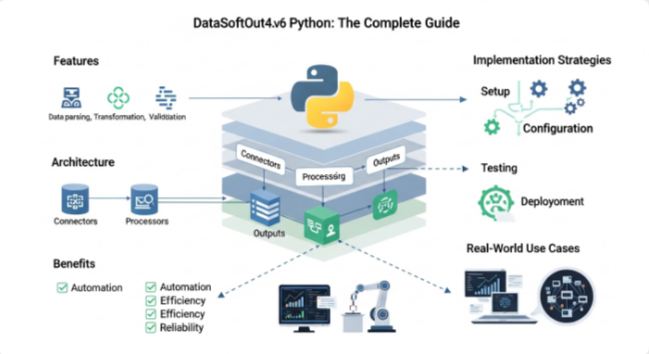
Although exact documentation may not be public, a logical architecture for data softout4.v6 python would include:
Data Input Layer
Handles ingestion from:
-
Local files
-
Cloud storage
-
SQL/NoSQL databases
-
External APIs
Processing Engine
Responsible for:
-
Cleaning and transformation
-
Filtering and aggregation
-
Statistical computation
-
Error handling
Output Module
Generates:
-
Structured exports
-
Visual summaries
-
Automated notifications
-
Integration endpoints
Configuration System
Likely includes:
-
YAML/JSON configs
-
Environment variables
-
Version control compatibility
This modular structure aligns with modern Python data engineering patterns.
Practical Use Cases
1. Business Reporting Automation
Companies can use data softout4.v6 python to:
-
Pull sales data nightly
-
Clean and standardize records
-
Generate PDF/Excel reports
-
Email stakeholders automatically
This eliminates repetitive manual reporting.
2. Data Migration and Transformation
During system upgrades, organizations must:
-
Extract legacy database data
-
Reformat schemas
-
Validate integrity
-
Load into new systems
A Python-based transformation framework fits perfectly.
3. Educational Data Analysis
Institutions can apply data softout4.v6 python for:
-
Student performance analytics
-
Attendance tracking automation
-
Curriculum outcome reporting
Python’s readability makes maintenance easier for academic IT teams.
4. Web Application Back-End Processing
Developers may integrate:
-
Scheduled cron jobs
-
API-driven data ingestion
-
Background analytics workers
This supports scalable web platforms.
Benefits of Using Data Softout4.v6 Python
Efficiency Gains
Automation reduces:
-
Human error
-
Processing time
-
Operational costs
Scalability
Python supports:
-
Parallel processing
-
Cloud deployment
-
Containerization
Flexibility
Because it’s script-based, developers can:
-
Modify logic quickly
-
Add integrations
-
Customize outputs
Maintainability
Readable code ensures:
-
Easier debugging
-
Faster onboarding
-
Long-term sustainability
Comparison With Traditional Data Tools
| Feature | Data Softout4.v6 Python | Legacy Tools |
|---|---|---|
| Automation | High | Limited |
| Customization | Extensive | Restricted |
| Cost | Low (open ecosystem) | Often expensive |
| Scalability | Cloud-ready | Hardware-dependent |
| Learning Curve | Moderate | Sometimes steep |
This highlights why Python-driven frameworks dominate modern data workflows.
Implementation Strategy
Step 1: Environment Setup
Typical setup would involve:
-
Installing Python 3.x
-
Creating virtual environments
-
Adding required libraries
Step 2: Data Source Configuration
Define:
-
File paths
-
Database credentials
-
API endpoints
Step 3: Processing Logic
Write scripts for:
-
Cleaning
-
Transformation
-
Aggregation
Step 4: Output Automation
Schedule:
-
Report generation
-
Data exports
-
Notification triggers
Step 5: Monitoring and Logging
Implement:
-
Error logs
-
Performance tracking
-
Alert systems
These steps ensure reliable deployment.
Best Practices for Data Softout4.v6 Python
1. Use Modular Code Design
Break logic into:
-
Functions
-
Classes
-
Reusable modules
2. Implement Robust Error Handling
Always include:
-
Try/except blocks
-
Validation checks
-
Logging mechanisms
3. Optimize Performance
Use:
-
Vectorized operations (pandas)
-
Caching
-
Parallel processing
4. Maintain Documentation
Clear documentation ensures:
-
Team collaboration
-
Easier upgrades
-
Reduced technical debt
Security Considerations
Any data framework must address:
-
Credential protection
-
Secure API calls
-
Data encryption
-
Access control
Python supports these through:
-
Environment variables
-
Secure libraries
-
Authentication tokens
Future Potential of Data Softout4.v6 Python
As data volumes grow, tools like data softout 4.v6 python may evolve toward:
-
AI-driven analytics
-
Real-time streaming pipelines
-
Cloud-native orchestration
-
Low-code automation layers
This positions the concept within the future of intelligent data engineering.
data softout4.v6 python: Common Challenges and Solutions
Challenge: Large Dataset Performance
Solution:
Use chunk processing, distributed computing, or optimized libraries.
Challenge: Integration Complexity
Solution:
Adopt standardized APIs and modular connectors.
Challenge: Maintenance Over Time
Solution:
Version control, automated testing, and documentation.
Why Developers Are Interested in Data Softout4.v6 Python
Growing interest comes from:
-
Demand for automation
-
Expansion of data-driven decision making
-
Python’s dominance in analytics and AI
-
Need for customizable internal tools
This makes data softout 4.v6 python a valuable conceptual framework.
Conclusion about data softout4.v6 python
Data softout 4.v6 python is more than just a keyword; it represents a new Python-based approach to structured data processing, output automation, and workflow management. However, it can be interpreted as a tool or framework, regardless of its status as a proprietary module. Its principles fit perfectly with new data engineering trends.
By utilizing the flexibility, automation, and availability provided by Python, any developer or organization has the ability to efficiently, securely, and scalably build upon a data softout4.v6 python methodology.
As the world of computers continues to evolve further into the data-centric landscape, frameworks built on these concepts will continue to evolve, and so, the time is absolutely perfect for looking into and implementing concepts like these using Python.